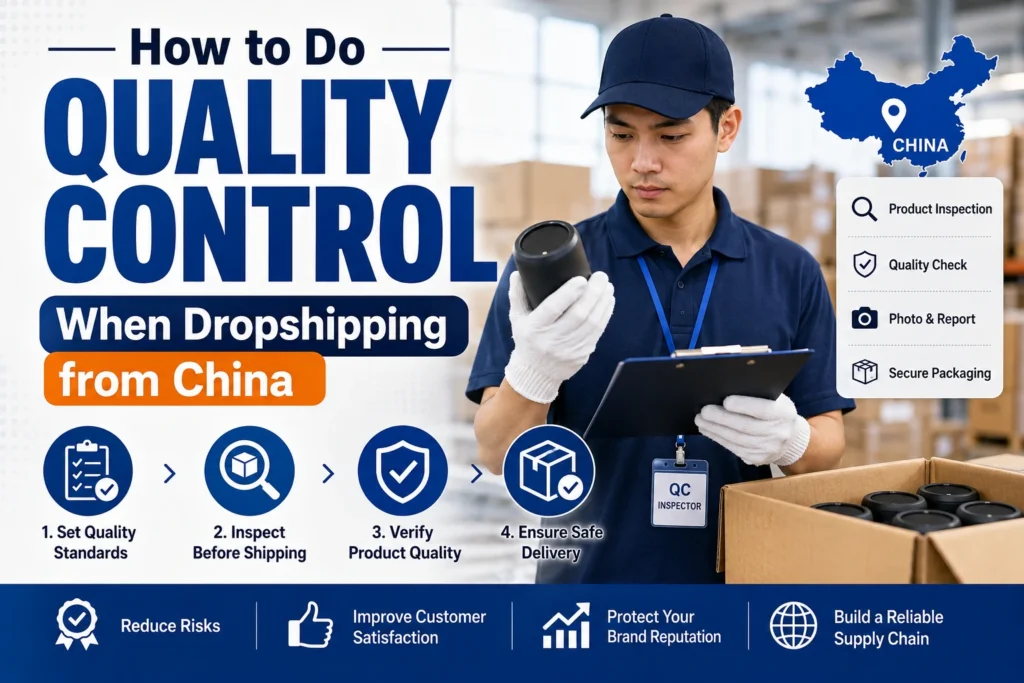
If you’re dropshipping from China, quality control is the single biggest factor that determines whether your business thrives or collapses. Nothing destroys a brand faster than customers receiving defective, mismatched, or substandard products — and once negative reviews start piling up, they’re nearly impossible to erase. Yet many sellers skip quality inspections entirely, trusting suppliers blindly and hoping for the best. In this guide, you’ll learn exactly how to implement quality control when dropshipping from China, what to inspect, when to inspect it, and how to build a system that scales.
Why Quality Control Matters in China Dropshipping
China manufactures an enormous volume of goods at highly competitive prices. Most factories are professional and reliable — but not all. Without a quality control process, you’re exposed to several real risks:
- Defective products: Electronics that don’t turn on, clothing with broken seams, gadgets with missing parts.
- Wrong items shipped: Wrong color, wrong size, wrong model — common when suppliers manage hundreds of SKUs simultaneously.
- Poor packaging: Items damaged in transit because they weren’t packed securely enough for international shipping.
- Non-compliance: Products that fail safety or certification standards required in the USA, EU, or Australia.
The cost of catching these issues before shipment is a fraction of the cost of refunds, replacements, chargebacks, and lost customers. A structured quality control dropshipping China process is not optional — it’s a core business function.
The Hidden Costs of Skipping Inspections
Many new dropshippers see quality inspections as an added expense and skip them to protect margins. This is a false economy. A single batch of defective products can trigger a wave of PayPal disputes, Shopify payment holds, negative reviews, and customer churn that costs 10x more than any inspection fee. Refund rates above 3-5% also signal to payment processors that your store is high-risk, leading to higher processing fees or account termination.
Types of Quality Control Inspections
There are four main types of inspections used in manufacturing and dropshipping. Understanding when to use each one is key to building an efficient quality control system.
Pre-Production Inspection (PPI)
A pre-production inspection happens before the factory starts making your products. The inspector verifies that the supplier has the correct raw materials, components, and equipment to meet your specifications. This is especially important for custom or branded orders — catching issues at this stage prevents costly rework later.
During Production Inspection (DPI)
Also called an in-line inspection, a DPI occurs when 10-40% of the order has been produced. Inspectors check random samples from the production line against your quality standards. If problems are found, the factory still has time to correct them before completing the full run. DPIs are ideal for large orders or products with tight tolerances.
Pre-Shipment Inspection (PSI)
The most common inspection for dropshippers, a pre-shipment inspection (PSI) occurs when at least 80% of the order is finished and packed. Inspectors pull random samples, check against AQL (Acceptable Quality Level) standards, test functionality, verify packaging, and confirm quantities. A PSI report tells you whether to approve shipment or request repairs before goods leave the warehouse.
Container Loading Inspection (CLI)
A CLI takes place when products are being loaded into shipping containers. Inspectors verify that the correct quantity of approved products is being loaded, packaging is intact, and nothing unauthorized is included. This is most relevant for large FCL (Full Container Load) shipments.
How to Vet Suppliers Before Placing Orders
Quality control starts long before production begins — it starts with choosing the right supplier. No amount of inspection can fix a fundamentally bad supplier relationship. Here’s how to vet Chinese suppliers effectively:
Factory Audits and Certifications
Ask potential suppliers for their business license, ISO certifications, and any product-specific certifications (CE, RoHS, FCC, etc.) required for your target market. Legitimate manufacturers will provide these without hesitation. For high-volume relationships, commissioning a factory audit through a third-party inspection company gives you an objective assessment of production capacity, quality management systems, and labor practices.
Sample Orders
Always order samples before committing to bulk orders. Evaluate the sample against your specifications in detail: dimensions, materials, finish quality, packaging, labeling, and functionality. Pay attention not just to whether the sample is acceptable, but to how quickly and accurately the supplier responds to your feedback — this reveals how they’ll handle issues at scale.
When you’re using a product sourcing service like EPAFulfill, experienced sourcing agents handle supplier vetting on your behalf, comparing multiple factories, verifying credentials, and securing the best price — saving you weeks of back-and-forth communication.
Setting Up Your Quality Control Checklist
A written quality control checklist is the foundation of consistent inspections. Without a checklist, inspectors — whether internal staff or third parties — have no clear standard to work against. Your checklist should be product-specific and cover the following areas:
- Visual appearance: Color accuracy, surface finish, printing quality, no scratches or dents
- Dimensions and weight: Measurements within tolerance of your spec sheet
- Functionality: Product works as intended (for electronics, mechanical items, etc.)
- Packaging: Box integrity, correct labeling, barcode scanning correctly, sufficient padding
- Quantity: Correct number of units, correct assortment of variants
- Safety and compliance: Required certifications present, no prohibited materials
- Branding elements: Logo correct, color matches brand guidelines, no typos on packaging
Share this checklist with your supplier before production begins. Clear expectations upfront reduce the chance of disputes after the fact.
AQL Sampling Standards Explained
AQL (Acceptable Quality Level) is an internationally recognized statistical sampling standard used to determine how many units to inspect and how many defects are acceptable. The most common AQL levels used in consumer goods are:
- AQL 1.5: Used for critical defects (safety issues, functional failures) — very strict
- AQL 2.5: Used for major defects (appearance, functionality that impacts usability) — standard
- AQL 4.0: Used for minor defects (small cosmetic issues that don’t affect function) — lenient
Most third-party inspection companies default to AQL 2.5 for major defects and AQL 4.0 for minor defects. For premium or high-value products, tighten the standards accordingly.
Using a China Fulfillment Agent for Quality Control
For most independent store owners, hiring dedicated QC staff in China isn’t practical. This is where a reliable China fulfillment agent becomes invaluable. A professional agent like EPAFulfill operates a physical warehouse in China with trained staff who inspect incoming goods from your suppliers before they’re shipped to customers.
EPAFulfill’s quality control service includes:
- Receiving and counting inventory from your suppliers
- Visual inspection against your product specifications
- Photographing products and flagging defects for your review
- Repacking or reboxing products to meet your branding standards
- Holding defective stock and coordinating returns to suppliers
This warehouse-level QC is especially powerful for sellers who source from multiple suppliers — instead of managing separate inspection processes for each vendor, everything flows through one centralized checkpoint. You get photo evidence of every batch, and you don’t ship a single unit you haven’t approved.
When to Use Third-Party Inspection Companies
For large orders (typically 500+ units), it may be worth supplementing warehouse QC with a dedicated third-party inspection company like Bureau Veritas, SGS, or QIMA. These companies send trained inspectors to the factory floor to perform pre-shipment inspections against AQL standards. Reports are detailed, professional, and defensible if you ever need to file a supplier dispute.
Handling Defective Products and Supplier Disputes
Even with robust quality control in place, defects will occasionally slip through. How you handle them determines the long-term health of your supplier relationships and your brand reputation.
Document Everything
When defective products are discovered — whether by your QC agent, a customer complaint, or a return — document the defect with photos and detailed notes. Record the batch number, supplier, shipping date, and nature of the defect. This documentation is essential for filing a claim with your supplier and for identifying patterns that indicate a systemic problem.
Negotiate Remedies Upfront
Before placing your first order with any supplier, agree in writing on what happens when defects are found. Common remedies include: supplier reworks or replaces defective units at their cost, partial refund proportional to the defect rate, or credit toward future orders. Having this agreed in advance removes ambiguity and speeds up resolution.
Quality Control Best Practices for Scaling Dropshippers
As your order volumes grow, your quality control processes need to scale with them. Here are the key practices that successful dropshippers implement as they scale:
- Standardize your spec sheets: Create a template and use it for every product. Consistent documentation makes supplier onboarding and inspections faster and more reliable.
- Build QC into your product costs: Factor inspection fees into your landed cost calculations from day one, not as an afterthought.
- Track defect rates by supplier: Maintain a simple spreadsheet tracking defect rates per supplier per batch. Use this data to make sourcing decisions and renegotiate terms.
- Use a fulfillment partner with QC capability: Partnering with a China agent that includes quality control in their service means you have a permanent, scalable QC infrastructure without hiring your own team.
- Set reorder triggers based on QC performance: Suppliers with consistently low defect rates earn more of your business. Suppliers with recurring issues get phased out.
Conclusion: Quality Control Is Your Brand’s Insurance Policy
Effective quality control dropshipping China is not about distrust — it’s about building a professional, repeatable process that protects your customers, your brand, and your profit margins. Whether you start with simple sample checks or implement a full AQL-based inspection workflow, the key is to begin now, before a bad batch costs you far more than any inspection ever would. With the right systems — and the right China fulfillment partner — you can source from China confidently and scale sustainably.
Ready to take the headache out of quality control? EPAFulfill’s end-to-end fulfillment service includes quality inspection, branded packaging, and reliable international shipping — so you can focus on growing your store, not firefighting supplier problems. Get in touch today to learn how we can protect your brand from day one.