Still confused about whether you need a china dropshipping agent or a fulfillment center for your online store? You are not alone. Thousands of Shopify and WooCommerce sellers face this exact dilemma when they first decide to source products from China and build a scalable dropshipping operation.
The truth is, both models exist on the same spectrum of order fulfillment, but they work very differently for your business. One gives you maximum control and customization. The other offers infrastructure and scale. Choosing wrong can mean delayed shipments, ballooning costs, and a customer experience that kills your reviews.
In this guide, we break down exactly what each model does, where they overlap, where they diverge, and how to decide which one belongs in your 2026 dropshipping strategy.
What Is a China Dropshipping Agent?
A china dropshipping agent is a person or company based in China that acts as your on-the-ground representative for product sourcing, quality control, and order coordination. Unlike a faceless supplier on Alibaba, a dropshipping agent becomes a real operational partner who speaks the language, knows the factories, and can handle the nuance that international commerce demands.
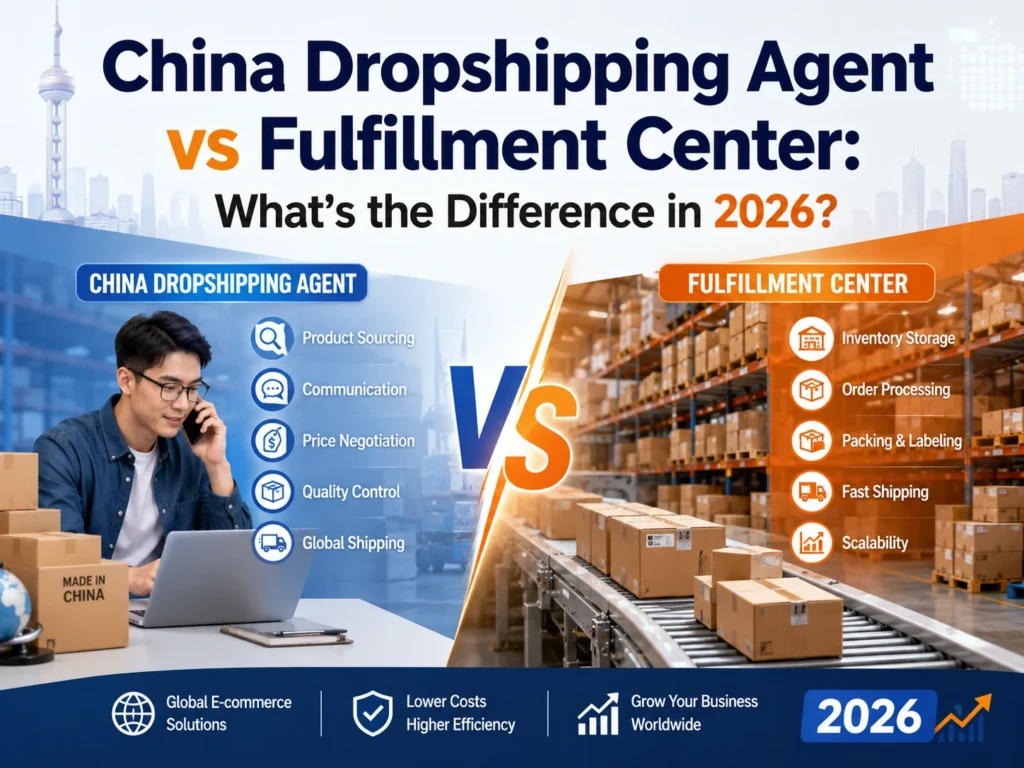
Key Responsibilities of a China Dropshipping Agent
- Supplier identification and vetting — finding reliable manufacturers, not just the cheapest ones
- Sample verification — physically checking products before you list them
- Order consolidation — combining multiple orders into single shipments to reduce your per-unit shipping costs
- Quality control checkpoints — inspecting goods at the warehouse before they leave China
- Custom packaging and branding — managing branded boxes, inserts, and poly bags for sellers building a brand identity
- Communication bridge — translating supplier conversations, resolving disputes, and managing expectations
How a China Dropshipping Agent Charges
Most dropshipping agents charge a flat service fee per order, a percentage of the product cost, or both. The fee structure varies, but you should expect somewhere between 5% and 15% of the order value, on top of the product and shipping costs. Some agents also charge for sample requests, product photography, and custom packaging setup.
Compare this to sourcing directly from Alibaba, where you might pay the listed factory price but spend hundreds of hours navigating MOQs, communication gaps, and quality surprises.
What Is a Fulfillment Center?
A fulfillment center is a warehouse facility — either in China or overseas — that stores inventory, picks items, packs them, and ships them to your customer when an order comes through your online store. Fulfillment centers are built for scale. They run on systems and processes rather than personal relationships.
The key distinction is inventory. Most fulfillment centers work on a pre-stock model. You buy inventory in bulk, ship it to their warehouse, and they handle the rest. Some modern fulfillment centers also support dropshipping directly from their supplier networks, but the infrastructure is fundamentally different from an agent.
Typical Fulfillment Center Services
- Inventory storage — holding your bulk stock for weeks or months
- Pick and pack — physically assembling customer orders
- Shipping label generation — automated label creation through platform integrations
- Returns processing — handling customer returns and restocking
- Kitting and bundling — combining multiple products into a single package
Fulfillment centers typically charge per-unit storage fees (monthly or daily) plus per-order pick-and-pack fees. If you are moving high volumes of consistent SKUs, this model can be extremely cost-effective. If you are testing products or running a catalog with low turnover, those storage fees quietly eat into your margins.
China Dropshipping Agent vs Fulfillment Center: The Core Differences
Here is how the two models stack up across the key operational factors that matter most to growing Shopify and WooCommerce sellers:
Operational Model and Inventory
The most fundamental difference comes down to inventory. A china dropshipping agent operates on a pure dropshipping basis: you list products, orders come in, the agent coordinates shipment directly from the manufacturer or their consolidation warehouse to your customer. There is no need to purchase inventory upfront.
A fulfillment center requires you to purchase inventory in bulk and ship it to their warehouse. When an order arrives, their team picks, packs, and ships it. You are paying for storage, infrastructure, and speed — but you also control the process more directly.
Setup Costs and Financial Risk
Starting with a dropshipping agent costs almost nothing. You pay per order, there is no warehouse commitment, and you can test products without financial exposure. A fulfillment center, by contrast, demands bulk MOQ purchases upfront, plus monthly storage fees, plus inbound shipping costs. For a new seller, this cash flow requirement can be prohibitive.
However, at scale — say 100+ orders per day on a proven product — the per-unit economics of a fulfillment center often beat the service fees of an agent.
Shipping Speed and Geography
Orders fulfilled through a china dropshipping agent typically arrive in 7-15 business days to customers in the US, UK, EU, or Australia. This is acceptable for many product categories and price points, especially if you set accurate delivery expectations on your product pages.
Fulfillment centers located in the destination country (US, UK, EU) can deliver in 1-3 business days. If your customers expect Amazon-level speed, this is not optional — it is a competitive requirement.
Quality Control
Here is where a china dropshipping agent often has a structural advantage. Because the agent is physically in China and connected to the production process, they can implement quality control checkpoints at the factory, upon warehouse receipt, and before final shipment. A fulfillment center in the US or EU can only inspect what arrives at their dock — by then, the product is already made.
If product quality is a significant concern for your catalog — and for electronics, home goods, and children’s products, it should be — an agent with a rigorous QC process is the safer choice.
Customization and Branding
Both models can support branded dropshipping, but the logistics differ. An agent can coordinate custom packaging directly with the factory — logo printing, branded boxes, thank-you cards, and poly bag printing — often at lower MOQs than a fulfillment center requires. A fulfillment center typically offers standard kitting and bundling services but may outsource custom printing to a third party, adding complexity and cost.
Technology and Platform Integration
Modern fulfillment centers usually offer deep Shopify and WooCommerce integration — automatic order importing, shipping label generation, and inventory sync. Dropshipping agents vary widely on this dimension. Some use manual spreadsheet workflows; others have API integrations that match or exceed fulfillment center capabilities. Always ask about their tech stack and whether they can connect directly to your store before committing.
When to Choose a China Dropshipping Agent
A china dropshipping agent makes the most sense when:
- You are starting out — low MOQs, no upfront inventory investment, and the flexibility to test new products without financial risk
- Your products are customizable — branded packaging, logo printing, or product configuration that requires a human touch to coordinate with the factory
- You are selling high-variation catalogs — dozens or hundreds of SKUs with unpredictable demand curves, making pre-stocking financially dangerous
- You need China expertise — supplier negotiation, factory visits, and Mandarin communication that you cannot replicate from overseas
- You sell globally — a good agent can ship from China directly to your customer anywhere in the world, often with better rates than you can negotiate yourself
Real Scenario: The New Store Owner
Imagine you have just launched a Shopify store selling customizable phone cases. You have 12 designs, you are not sure which will sell, and your initial budget is $500. A fulfillment center would require you to buy hundreds of cases upfront and pay monthly storage fees. A china dropshipping agent lets you list all 12 designs, fulfill orders as they come in, and only pay for what you sell.
When to Choose a Fulfillment Center
A fulfillment center becomes the smarter choice when:
- You have validated product-market fit — you know exactly which SKUs sell, at what volume, and can confidently forecast inventory needs
- Speed is a competitive advantage — if your customers expect 2-3 day delivery in the US or Europe, shipping from a China-based agent or warehouse will not cut it
- You are running high-volume, consistent SKUs — the math on bulk MOQs and storage fees works in your favor once volume crosses a threshold
- You need complex logistics — multi-channel fulfillment, FBA prep, or integration with major retailer networks
Real Scenario: The Scaling Brand
You have been selling LED strip lights on your WooCommerce store for 18 months. You are doing 200 orders per day, your return rate is under 2%, and you have locked in a supplier you trust. At this stage, it makes sense to buy inventory in bulk, ship it to a US or EU fulfillment center, and offer next-day delivery to your customers. Your margins improve and your customer experience gets a significant upgrade.
Can You Use Both at the Same Time?
Absolutely — and many successful brands do. The most common hybrid model looks like this:
- Use a china dropshipping agent for product sourcing and testing new products at low risk
- Once a product validates, transition proven SKUs to a fulfillment center for faster domestic delivery
- Keep your agent relationship for custom or seasonal products that do not make sense to pre-stock
This layered approach gives you the best of both worlds: the agility to test and learn from an agent, and the speed and cost efficiency of a fulfillment center for your hero products.
How to Evaluate Any Partner — Agent or Fulfillment Center
Whether you are interviewing a potential china dropshipping agent or vetting a fulfillment center, the evaluation criteria are remarkably similar:
- Transparency on fees — every cost should be explicit, no hidden charges buried in fine print
- Communication responsiveness — how fast do they reply? In what timezone? In what language?
- Quality control process — do they inspect every order, sample-based, or not at all?
- Technology integration — can they connect to your Shopify or WooCommerce store via API or plugin?
- Shipping network — which carriers, what countries, what typical transit times?
- Branding capabilities — if you care about custom packaging, can they handle it and at what minimum quantity?
For sellers who prioritize quality control in their dropshipping operation, this is the single most important evaluation factor. A partner that skips inspection to save time is a partner that will eventually cost you in returns, negative reviews, and account suspensions.
Conclusion: The Right Model Depends on Where You Are
There is no universal answer to the china dropshipping agent vs fulfillment center debate. The right choice depends entirely on your stage, your product catalog, your customer expectations, and your growth ambitions.
If you are starting out, scaling, or selling products that require customization or global distribution, a reliable china dropshipping agent is your most strategic partner. If you have proven products, high volumes, and customers who need domestic speed, a fulfillment center is the infrastructure upgrade you need.
And if you want expert help figuring out which model fits your business right now? EPAFulfill’s team of China dropshipping specialists works with Shopify and WooCommerce sellers to build the exact fulfillment model their growth stage demands. Book a free consultation and get a custom fulfillment strategy built for your store.