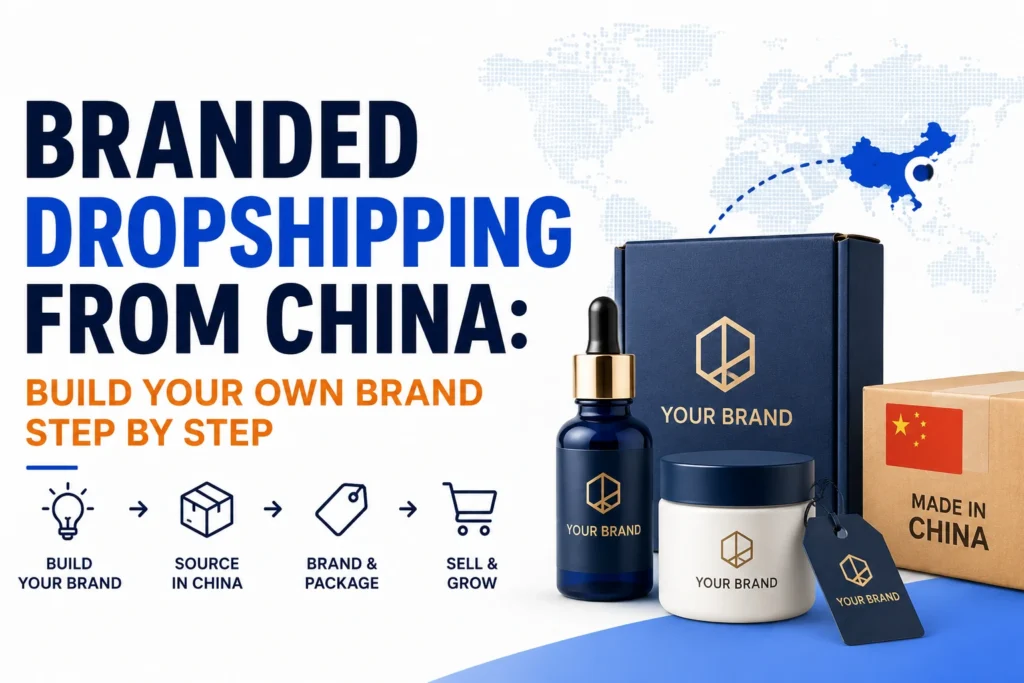
Most dropshippers are selling the exact same products as thousands of other stores. Same AliExpress photos, same generic packaging, same race to the bottom on price. If you want to stand out, build a real asset, and charge premium prices, you need a different approach. That’s where branded dropshipping from China comes in. Instead of being another faceless reseller, you become a brand that customers recognize, trust, and return to. This guide walks you through every step of building your own branded dropshipping business from China — from finding the right supplier to delivering a branded unboxing experience.
What Is Branded Dropshipping and Why It Matters
Branded dropshipping means selling products under your own brand name, logo, and packaging — rather than shipping generic, unbranded items. It sits between traditional dropshipping (low investment, low margins, zero brand equity) and private labeling (high investment, inventory risk, full control). With branded dropshipping from China, you get the best of both worlds: low upfront costs and no inventory risk, combined with the differentiation and customer loyalty that only a brand can deliver.
The numbers tell a clear story. Generic dropshipping stores typically see profit margins of 10-20%, while branded dropshipping stores can command 30-50% margins. Why? Because when customers see your logo on the box, a custom thank-you card inside, and consistent branding across your store, they perceive higher value. They’re also far more likely to remember your store name and come back. A generic store is forgettable; a branded store builds customer lifetime value — the single most important metric in ecommerce.
Branded Dropshipping vs Private Label vs White Label
These terms are often confused, so let’s clarify. Private label means you manufacture a unique product under your brand, typically requiring minimum order quantities (MOQs) and upfront inventory investment. White label means you buy a generic product and put your brand on it — no product modification, just branding. Branded dropshipping is the hybrid: you sell products on demand using a supplier who can add your logo, custom packaging, and branded inserts on a per-order basis. You keep zero inventory, pay no MOQs, and still deliver a branded experience. For most early-stage ecommerce entrepreneurs, branded dropshipping from China is the most accessible path to building a real brand without risking thousands on inventory.
Finding the Right Branded Dropshipping Supplier in China
Not every Chinese supplier offers branded dropshipping services. Many factories are set up for bulk production only and won’t customize packaging for individual orders. Your first challenge is identifying suppliers who specialize in branded dropshipping from China. Here’s what to look for:
- Custom packaging capability: Can they print your logo on boxes, poly mailers, or product packaging? Ask for photos of previous custom packaging work.
- Custom inserts support: Can they include thank-you cards, discount codes, user manuals, or marketing materials inside each package?
- Label and hang tag printing: For apparel and accessories, can they produce and attach branded hang tags or woven labels?
- No MOQ for branded orders: Some suppliers advertise branding but require minimums of 100+ units. Confirm they can process branded orders one at a time.
- Quality consistency: Branding means nothing if the product quality varies from order to order. Look for suppliers with documented quality control processes.
When you’re evaluating suppliers, use a product sourcing service that has pre-vetted relationships with manufacturers. This saves weeks of back-and-forth and reduces the risk of partnering with an unreliable factory. A good sourcing partner will also negotiate better rates on your behalf and handle language barriers and cultural nuances that can complicate supplier relationships.
Questions to Ask Before Committing to a Supplier
Before you place your first branded order, send these questions to any potential supplier:
- What file format do you need for the logo? (Vector files like .AI or .EPS are standard)
- What printing methods do you offer? (Screen printing, heat transfer, UV printing, embroidery, laser engraving)
- Can you provide photos of finished branded orders from previous clients?
- How much does branding add per unit? (Typically $0.50-$3.00 depending on complexity)
- What’s the turnaround time for a branded order vs a standard order?
- Do you offer branded packaging beyond the product itself — custom boxes, tissue paper, stickers?
If a supplier is vague about any of these questions, move on. Serious branded dropshipping suppliers have clear processes and can show examples of their work within minutes.
Designing Your Brand Identity for Dropshipping
Your brand is more than a logo — it’s the entire visual and emotional experience customers have with your business. For branded dropshipping from China to work, you need a coherent brand identity that translates across your website, product packaging, and marketing materials. Start with the fundamentals:
Brand name: Choose something short, memorable, and easy to spell. Avoid generic-sounding names or anything too similar to existing brands. Check domain availability, social media handles, and trademark databases before committing.
Logo: You don’t need a $5,000 agency logo. Use tools like Canva, Looka, or hire a designer on Fiverr or 99designs. What matters is that the logo looks professional when printed on product packaging — test it at small sizes before finalizing. A clean, simple logo prints better than an intricate, detailed one.
Color palette: Pick 2-3 primary colors and 1-2 accent colors. These will define your packaging, website, and social media presence. Consistent color use across all touchpoints is what makes a brand feel professional and trustworthy.
Packaging design: Work with your supplier to understand what’s possible. Custom-printed poly mailers are the most cost-effective option. Custom boxes elevate the experience further but cost more and may affect shipping rates. For many brands selling products in the $30-80 range, a custom poly mailer plus a branded insert card hits the sweet spot between cost and impact.
Creating Brand Inserts That Drive Repeat Purchases
A brand insert is a card or flyer placed inside the package. Done right, it’s your most powerful customer retention tool. Here’s what to include:
- Thank you message: Simple, sincere, and on-brand. “Thanks for choosing [Brand Name]” goes a long way.
- Discount code for next purchase: Give 10-15% off their next order. This single tactic can double your repeat purchase rate.
- Social media handles: Invite customers to follow you and tag you in photos. User-generated content is free marketing.
- Care instructions or usage tips: For products like apparel, electronics, or home goods, this adds genuine value and reduces returns.
- A story about your brand: One or two sentences about why you started the brand. People connect with stories, not logos.
Quality Control: Protecting Your Brand Reputation
A branded product with a quality defect does more damage than an unbranded one — because now the customer associates the bad experience with your brand specifically. For branded dropshipping from China, rigorous quality control is non-negotiable. Every branded item that leaves the supplier’s warehouse carries your reputation with it.
The most effective quality control process for branded dropshipping includes three stages. First, request pre-production samples of the branded version of your product. Check print quality, logo placement, packaging durability, and overall presentation. Second, implement pre-shipment photo verification — require your supplier to send photos of each branded order before it ships. Third, work with a partner that provides professional quality control inspections. A dedicated QC team checking for defects, print errors, and packaging damage before items reach your customers is worth every penny.
Also establish clear quality standards with your supplier upfront. Define acceptable defect rates (AQL standards), specify packaging requirements in writing, and agree on how defects will be handled — replacement, refund, or rework. Put everything in writing. Verbal agreements with Chinese suppliers are unreliable; written specifications protect both parties.
Setting Up a Branded Order Workflow
Once you’ve established your brand identity and quality standards, systematize the workflow. A typical branded dropshipping order flow looks like this:
- Customer places order on your Shopify or WooCommerce store
- Order details (including SKU, branding requirements, and customer address) are sent to your fulfillment partner
- Supplier picks the product, applies custom branding (logo, packaging, inserts)
- Quality check is performed on the branded item
- Order is packed and shipped with tracking information
- Tracking is pushed back to your store and sent to the customer
Working with a comprehensive branded dropshipping service simplifies this enormously. Instead of coordinating with multiple factories, packaging suppliers, and shipping carriers, you have one partner handling the entire branded fulfillment pipeline. EPAfulfill, for example, offers end-to-end branded dropshipping including custom packaging, logo application, branded inserts, quality inspection, and worldwide shipping — all from a single dashboard.
Shipping and Logistics for Branded Products
Branded packaging adds a layer of complexity to shipping. Custom boxes and inserts add weight and volume, which affects shipping costs. You need to optimize packaging for both brand impact and shipping efficiency. Here are the key considerations:
Weight and dimensional weight: Shipping carriers charge based on whichever is higher — actual weight or dimensional weight (volume). A large, lightweight branded box can actually cost more to ship than a compact, heavier one. Work with your supplier to find packaging that’s branded but not oversized.
Shipping methods: For branded dropshipping from China, you typically have three shipping options. Standard shipping (7-15 days) is the default and most cost-effective for customers who aren’t in a rush. Expedited shipping (3-7 days) works for higher-value orders where customers expect faster delivery. Express shipping (2-5 days) via DHL, FedEx, or UPS is for premium products or urgent orders.
Tracking and customer communication: Branded stores need reliable tracking. Use a fulfillment partner that provides end-to-end tracking from the warehouse to the customer’s doorstep. Set up automated tracking update emails in your ecommerce platform — customers who receive proactive shipping updates are less likely to open support tickets or request refunds.
International Shipping Considerations
When shipping branded products internationally from China, be aware of customs regulations, duties, and taxes in your target markets. Some countries have stricter requirements for imported goods than others. The European Union, for example, requires product compliance documentation (CE marking) for many categories. The United States has import duties that vary by product type and value. Australia has strict biosecurity requirements for certain goods. A professional fulfillment partner will handle customs documentation and help you navigate these complexities so your branded packages don’t get held up at the border.
Scaling Your Branded Dropshipping Business
Once your branded dropshipping operation is running smoothly, the next phase is scaling. Scaling a branded business is fundamentally different from scaling a generic dropshipping store. With a generic store, you add more products. With a branded store, you deepen your brand presence, expand your product line within your niche, and invest in customer retention.
Expand your product line: The easiest growth move is launching complementary products under the same brand. If you sell branded yoga mats, add branded yoga blocks, straps, and water bottles. These products share the same customer, the same brand identity, and often the same supplier relationships. Cross-selling related products can increase average order value by 30-50%.
Invest in content and community: Branded stores thrive on content marketing and community building. Create blog posts, YouTube videos, and social media content around your niche. Build an email list and send weekly newsletters with product tips, customer stories, and exclusive offers. A branded business with 1,000 engaged email subscribers will consistently outperform a generic store with 10,000 one-time visitors.
Optimize your operations: At scale, small inefficiencies become large costs. Audit your fulfillment process quarterly. Are shipping times consistent? Are defect rates under 2%? Are branded insert costs optimized? EPAfulfill’s integrated platform handles these operational details, freeing you to focus on marketing and product development — which is where your time creates the most value as a brand owner.
Leverage customer reviews and UGC: Branded products generate better reviews, which in turn drive more sales. Actively request reviews from every customer. Feature positive reviews prominently on your product pages. Encourage customers to share photos and videos of their purchases on social media. This user-generated content is the most authentic and effective marketing you’ll ever have — and it costs nothing.
Conclusion: Your Brand Is Your Biggest Asset
Generic dropshipping is a short-term play. You make some sales, then competitors copy your products, undercut your prices, and you’re back to square one. Branded dropshipping from China is a long-term play. Every order you fulfill builds your brand equity. Every branded package that arrives at a customer’s doorstep is a marketing touchpoint. Every positive review strengthens your reputation.
The steps are clear: find a reliable branded dropshipping supplier, design a professional brand identity, implement quality control, optimize your shipping, and scale with complementary products. It’s not complicated — but it requires discipline and the right partners. Ready to stop being just another dropshipper and start building a real brand? Explore EPAfulfill’s branded dropshipping services and get your branded packaging, inserts, and fulfillment set up in days — not months.